
Bed Bug FAQ
Everything you need to know
Everything you need to know
about bed bugs.
Complete, honest answers from XTERMIN's bed bug specialists. No fluff, no scaremongering — just the real information you need to understand the problem and make a confident decision.
24-Month
Bed Bug Free Guarantee
~94%+
K9 detection accuracy
6–8 hrs
Heat treatment duration
0%
Starting APR (financing)
Same day
Calls often available
Why early action matters
One female can lay 200–500 eggs in her lifetime.
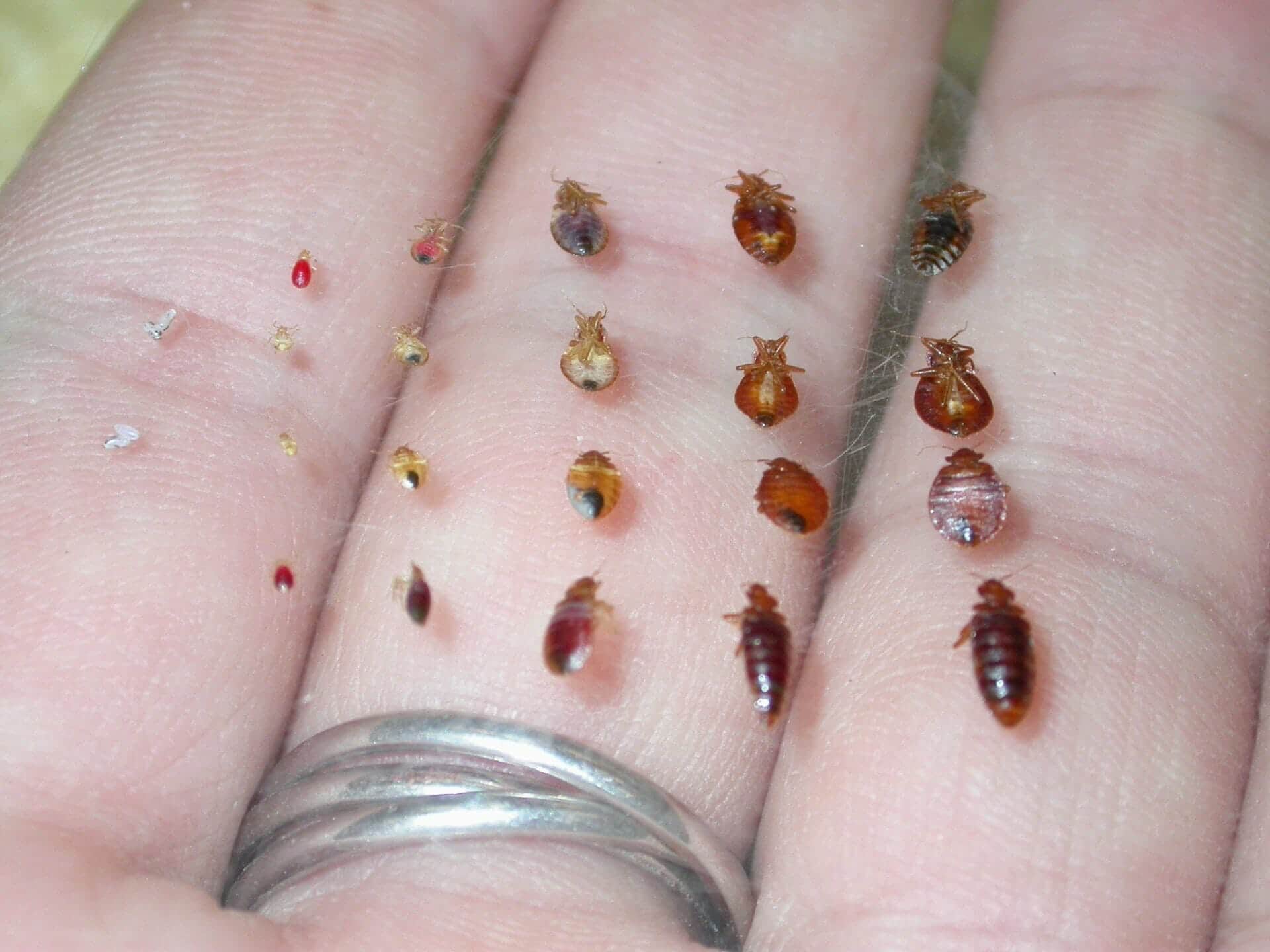
Bed bugs progress through five nymph stages before reaching adulthood. At each stage they need a blood meal to molt. A contained early infestation treated today is a fraction of the cost and effort of a mature colony discovered months later.
Section 1
What do bed bugs look like?
Adults are reddish-brown, about the size of an apple or watermelon seed, and flat unless they've recently fed. They have horizontal texture lines across their back, no wings, and cannot fly or jump — they crawl. They have six legs and all the legs appear to protrude from the 'forward' half of their body. Bed bugs are never black in color. If you find a black bug — good news — it's not a bed bug.
Nymphs are cream-colored and somewhat translucent. If they've fed recently they may appear red or have a dark spot in their abdomen. Bed bugs go through five nymph stages before reaching adulthood.
Adult bed bugs are easily visible as they are about the size of an apple seed, reddish-brown — but look in the dark hiding areas like folds of fabric on your couch, recliner, mattress, bedding or skirting, cracks and crevices of your bed frame and baseboards and around bolt and screw heads of bed frames. Early-stage nymphs are nearly invisible to the naked eye, which is another good reason why K9 inspections are awesome.
Section 2
Bed bug behavior
Nope. Bed bugs do not jump or fly. They only crawl and hitchhike — better than a guitar-carrying hippie in tie-dye.
Yes. Bed bugs feed while you're sleeping, piercing the skin with a straw-like mouthpart similar to a mosquito. They typically attach 3–5 times in a single feeding. A common early sign: clusters or lines of 3–5 bites on your skin in the morning that weren't there when you went to bed.
Up to as long as 12 months, depending on temperature, humidity, and life stage. However, bed bugs typically feed once every 4–7 days if they feel comfortable, safe, and a human food source is present. Now if you blast a bunch of foggers or bad chemicals, bed bugs will often stop feeding for a while until they feel 'safe' again.
No. Bed bugs feed for 5–20 minutes then crawl back to their hiding spot. They do not live on their host the way ticks and lice do. You'll rarely find them on your body during the day.
Primarily at night when you're sleeping. They pierce skin with a straw-like mouthpart, attach 3–5 times per feeding, feed for 5–20 minutes, then crawl back to their hiding spot. They do NOT live on their host.
Once every 4–7 days when comfortable. They may stop temporarily if conditions feel unsafe. Bed bugs can survive up to 12 months without feeding — so the absence of bites doesn't mean the absence of bugs.
Think you've got bed bugs? Phone quote in 10 minutes.
Serving greater Phoenix & Arizona. Honest answers, 1,000+ treatments, 4.9 stars.
Section 3
Signs of bed bugs & how they spread
The most common signs: (1) Clusters or lines of 3–5 bites on skin in the morning. (2) Dark gray liquid stains on bedding — bed bug fecal matter is always liquid, like a felt-tip marker touching fabric. (3) Tiny yellowish eggs the size of a grain of rice in mattress seams. (4) Shed exoskeletons behind the headboard or in seams.
Be suspicious of bed bugs if you wake up with clusters or lines of bites that weren't there before bed — especially if you know you weren't exposed to mosquitoes. Also look for dark gray liquid stains on your bedding the size of the small tip of a felt-tip marker (most common to find), tiny yellowish eggs in mattress seams (rarely seen by homeowners unless the infestation is severe — and if that's the case, you've already seen bed bugs), or shed exoskeletons typically in the dark hiding areas. When in doubt, call us. A free phone consultation takes 10 minutes.
Common sources: used furniture or mattresses, luggage from hotel stays, Airbnbs, house guests, movie theater seats, airport seating, doctor's office chairs, and vacation rentals. They do NOT live outside. Your dog did not bring them in from the yard.
Bed bugs are efficient hitchhikers. They get in on used furniture, luggage, backpacks, shoes, and clothing. You can pick them up visiting someone with bed bugs or sitting in an infested seat at a movie theater, airport, or doctor's office. In multi-family buildings they can sometimes travel between units through shared walls, plumbing, and electrical conduit. They don't live outside and didn't come from outside — unless your kid was playing 'monkey's jumping on the bed' on a dirty mattress sitting on the curb.
Technically yes. Practically — rarely. Bed bugs can feed on both humans and animals. Your dogs, cats, and other pets are at risk during an infestation. The more severe the infestation, the higher the possibility bed bugs are feeding on them. That said, bed bugs strongly prefer humans — they'll go for your pets when humans aren't available, not as a first choice. More for survival. But bed bugs don't live on their host — so they don't live on your pets. If they do happen to feed on them, they probably crawled off before sunrise.
They prefer humans but will bite dogs and cats when humans aren't available. Your pets didn't bring them home from outside.
Yes — through shared walls, plumbing, and electrical conduit in multi-family buildings. Adjacent hotel rooms are also a common transmission path.
Bed bugs spread by hitchhiking on people or belongings from an infested location — places where humans sit, sleep, or spend extended time. Moving infested furniture or clothing between rooms or between homes is one of the fastest ways to spread them further.
Section 4
How to get rid of bed bugs
Depends on the treatment. Heat treatment: bed bug free in 8 hours, sleep in your own bed that night. Chemical treatment: plan on seeing some live activity for up to 60 days. It's not failing — eggs are hatching, nymphs are crawling through the treatment and dying. Patience required.
Professional structural heat treatment. Your entire home reaches 120–150°F simultaneously, killing every bug and every egg in a single 6–8 hour visit. By the end of treatment, every bed bug, nymph, and egg is dead — and you sleep in your own bed that night.
DIY is possible with patience, research, and realistic expectations. Your options are renting heaters or applying chemicals. Rented heaters are typically underpowered for whole-home treatment and only work well on a single room under ideal conditions. DIY chemical treatment requires the right products, correct application, and a lot of patience — plan on seeing live activity for 60 days or more.
Most common products people try that do NOT work and often make things worse by causing bed bugs to spread and build chemical resistance:
- Diatomaceous Earth (DE)
- Bed bug bombs and foggers
- Hot Shot branded sprays
- All "bed bug" sprays sold at big box retailers
- Most pyrethroid-based insecticides
- Lavender oil and essential oils
Here's what actually happens: you apply the product, some bugs die, you think it's working. The survivors smelled the chemical and scattered to other rooms. The eggs are untouched. The next generation is more resistant. Weeks later you apply again with less success. Months later you call us. We've seen this hundreds of times. It's not too late — we can fix it.
Natural remedies — essential oils, tea tree, lavender, cayenne, baking soda, rubbing alcohol — will not eliminate an infestation. Some may kill a bug on direct contact. None penetrate harborage areas, none kill eggs, and none will solve your problem. They'll delay your getting real treatment while the infestation grows.
Sometimes — under very specific circumstances. Rented heaters run on electricity and typically output 10,000–20,000 BTU. XTERMIN's heaters output over 900,000 BTU. Ours are up to 90 times more powerful — that's not a typo.
Rented heaters can work on a single room if the infestation is truly contained there, you prep correctly, and you sustain lethal temperatures throughout. That's a lot of ifs. The bigger risk: heating only part of your home drives bed bugs into untreated rooms, making things worse. We've treated many homes after multiple failed rental heater attempts.
Not reliably. DE may kill some bugs on direct contact but will not eradicate an infestation. We've treated hundreds of homes where the homeowner spread DE everywhere and waited — while the infestation spread. It's one of the most common things people try before calling us.
No — and we'd steer you away from any company using it as a primary treatment method. A steamer wand can't reach inside walls, box springs, or nightstands. Bed bugs are heat-sensitive and will simply crawl away from a slow-moving wand. Move it faster and the heat doesn't penetrate crevices. Ineffective from every angle.
We strongly discourage the use of store-bought sprays, foggers, or dusts. Products labeled 'Hotshot' and similar actually repel bugs and cause spreading throughout your home and to neighboring units if you're in an apartment. The bugs you spray directly will likely die so you'll think you won — but the eggs are still viable and the bugs that are hiding will smell the chemical and move to other areas, like up to the corners of your ceilings or down the hall. Most customers who call us have already tried this. It's not too late — we can fix it.
Section 5
Bed bug treatment options
Heat treatment kills all bed bugs AND bed bug eggs in 6–8 hours for the average size house, and requires only one visit. Chemical treatment is lower cost but takes 30–60 days, does not kill eggs immediately, and may require multiple visits.
Not even close. XTERMIN uses the most powerful commercial heaters available to heat your entire structure — walls, furniture, every room — to lethal temperatures (120–150°F) simultaneously. That's the key word: simultaneously. When the whole house heats at once, there's nowhere for bed bugs to escape. Some companies use underpowered heaters that require them to move room to room over 18–24 hours. That approach creates survivable cold zones — and bed bugs are very good at finding them. Others have tried steamers. They usually stop pretty quickly once they see the results. One-room and partial heat treatments do exist for the right circumstances, but they require careful execution to prevent bed bugs from migrating out of the treatment area during heating. We'll tell you honestly whether a partial treatment makes sense for your situation — or whether it's a risk not worth taking.
Proper preparation is critical — it's one of the few things that can affect the outcome of an otherwise solid heat treatment. Most people need 2–3 days to prep. Some can do it in a few hours; others need a week, depending on how much they have and how organized their home is. When you book with XTERMIN we send complete, detailed prep instructions. Follow them completely.
Yes. A dog's nose is roughly 10,000 times more sensitive than a human's — giving them the ability to detect the unique scent of a live bed bug or viable egg. It's the same principle as drug-sniffing dogs, just applied to pest detection. A trained bed bug K9 team consistently outperforms even the most experienced human visual inspector, particularly for early-stage or hard-to-find infestations. It's one of the most reliable detection tools available.
Do not move items between rooms. Moving infested items spreads the infestation. If you have bed bugs in the bedroom, don't take your blankets to the couch — that's how you get couch bugs too.
With XTERMIN's heat treatment — never — unless it's a 3rd generation hand-me-down that you secretly hate and want a good excuse. With chemical treatment — sometimes it's a good idea but usually not necessary. Heat treatment penetrates mattresses, sofas, bed frames — all of it. You'd be throwing out hundreds or thousands of dollars worth of furniture for no reason while the bugs inside your walls remain completely untouched. If you insist on discarding something, wrap it completely in stretch wrap first so you don't drop bugs in other parts of the home on the way out.
You've done the research. Now let's fix it.
Serving greater Phoenix & Arizona. 1,000+ treatments. 4.9 stars. Call us now.
Section 6
Bed bug treatment cost
Most heat treatments run $800–$2,000+ depending on home size and logistics. Unlike most competitors, we don't require an in-home inspection to give you a real number — we quote over the phone in about 10 minutes. Call (480) 999-9917.
Heat treatment for a full home runs $800–$2,000+ depending on size. Chemical treatment starts as low as $249. Call for a free phone quote in about 10 minutes — no pressure, no obligation: (480) 999-9917.
Chemical treatment typically runs 50–70% of the cost of heat treatment — making it attractive upfront. But factor in the full picture: mattress encasements ($40–80 each), possible furniture replacement, laundry expenses, and potentially a post-treatment K9 inspection (~$350–450) if your employer requires proof of clearance before returning to work. Chemical is cheaper to start. It's not always cheaper to finish.
Start with your lease. Most agreements address pest control responsibility — read it, it's your legal agreement. If bed bugs aren't specifically mentioned it falls under general pest control language. In large apartment complexes, management typically requires you to use their contracted pest control company — those contractors usually only offer chemical treatment and are rarely bed bug specialists. Some tenants successfully push for permission to hire outside bed bug experts (ahem). If you rent a house, most landlords expect the tenant to cover it.
Section 7
XTERMIN bed bug treatment — your questions answered
XTERMIN offers the industry's best Bed Bug Free Guarantee — 24 months — with full-structure heat treatment. Most competitors offer only 30–90 days. Call for details.
Our bed bug K9 teams detect bed bugs with ~94%+ accuracy using their sense of smell — far beyond what any visual inspection can reliably find. Perfect for movie theaters, call centers, care-home facilities, apartments, hotels, multi-family buildings, and peace-of-mind all-clear verifications. Need the best and most reliable inspection — call us.
Same-day calls are available in most Phoenix metro areas. We prioritize bed bug calls — we know you're not sleeping until this is handled. Even better — we can usually get you all the answers you need over the phone without you even having to wait for an inspection. But if an inspection is necessary, we'll get you scheduled fast.
Yes — we've partnered with Wisetack for flexible financing from 3 to 120 months, rates from 0% APR. Check your rate in 60 seconds with no credit score impact.
We serve all of greater Phoenix metro, plus we travel up to ~3.5 hours for heat treatments — including Prescott, Payson, Tucson, Show Low, Flagstaff, Globe/Miami, and Casa Grande.
If treated by us? Unlikely. And if they do somehow return during our industry-leading bed bug free guarantee, we come back.
Ready to solve your bed bug treatment problem?
Free phone quote · Same-day calls available · No contracts